Going Grey Gracefully: A Step-by-Step Transition Guide for Women Over 50
There comes a moment, usually in front of a bathroom mirror, when you look at your roots and think: what if I just stopped? Because you are tired of the dye, the roots, and the appointments. If that moment has arrived, this guide is for you. This guide walks you through a grey hair transition, step by step, so the change looks planned, not accidental.
A grey hair transition is the process of moving from dyed hair to your natural grey, in a way that looks planned rather than accidental. The grey itself is not the hard part. Grey hair can look striking and completely deliberate. The hard part is the grow-out line, that sharp band where dye meets new grey. This guide gives you a clear plan for those months.

Photo: Pexels
First, Decide What Your Grey Actually Looks Like
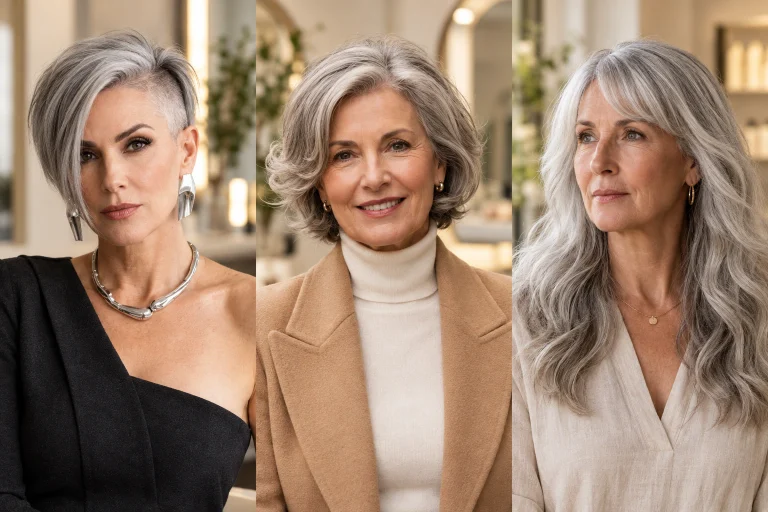
Before you choose a route, find out what you are growing towards, because not all grey is the same. Look at your roots in natural daylight. Most women over 50 fall into one of three patterns.
Salt-and-pepper is a mix of dark and grey strands. It is the most forgiving pattern, as the line between dye and new growth is softer.
Solid silver or steel grey is mostly grey with very little dark hair left. The contrast with dark dye is strong, so the grow-out line will be obvious, but the end result is often the most dramatic.
White or near-white is the lightest pattern, and it can look almost luminous once it is fully grown out. The catch is that white hair shows yellowing more easily, from sun, heat, and product build-up, so care matters more.
Ask your stylist which pattern they see. Where grey falls around your face also changes how it frames you, so before your consultation, look at our complete guide to choosing a haircut for your face shape.
The 4 Ways to Transition
There are four main routes to grey. The right choice depends on your current colour, your patience, your budget, and how much change you can live with at once. Each route is a different way to manage a grey hair transition, so choose by your current colour, your patience and your budget.
1. Full Grow-Out
How it works: You stop dyeing and let your grey grow in, trimming the dyed ends away little by little.
Who it suits: Women with salt-and-pepper grey, patient women, and women who do not mind a visible line for a while.
Time, cost, and visits: Expect 12 to 24 months for shoulder-length hair. Cost is the lowest of all four routes, roughly GBP 0 to GBP 40 per trim every 8 to 10 weeks, plus a purple shampoo at home. The trade-off is the visible line, at its worst around months 3 to 6.
2. Blending With Highlights and Lowlights
How it works: Your stylist adds fine silver and grey highlights, plus a few soft lowlights, through the dyed hair. The mix breaks up the hard line and makes the new grey look like part of the colour.
Who it suits: Almost everyone. It suits women with dark dye especially well, and women who want to look polished during the transition.
Time, cost, and visits: Expect 6 to 18 months to reach fully natural grey. A blending appointment costs roughly GBP 80 to GBP 180, every 6 to 8 weeks at first, then every 8 to 10 weeks. It is the most expensive route, but it looks best in the awkward middle stage. Ask for a silver money piece at the front hairline, as it frames the face.
3. The Big Chop / Short Cut
How it works: You cut off most of the dyed length in one bold move, often to a pixie or a short bob, and let the grey grow in from a short base.
Who it suits: Women who are ready for a real change and whose grey is already strong at the roots.
Time, cost, and visits: You can be fully grey in 3 to 6 months. A restyle cut costs roughly GBP 40 to GBP 90, with a trim every 4 to 6 weeks at roughly GBP 25 to GBP 50. The cost is low and the result is fast, but if you love your long hair, a sudden chop can feel like a loss.
4. The Dye-Strip Method (the “Secret” Route)
How it works: Your stylist colours only the top layer of your hair to match your natural grey, while the grey underneath grows untouched. From the outside, your hair looks silver, and no harsh line ever appears.
Who it suits: Women who want to look grey now, without months of two-tone hair. It suits straight and wavy hair best, and it is kind to dry or damaged hair, as it avoids bleach.
Time, cost, and visits: Expect 9 to 15 months to reach fully natural grey. A dye-strip appointment costs roughly GBP 70 to GBP 150, with a top-up every 6 to 8 weeks at first. Describe it rather than asking for it by name: “Can you colour just the top layer to match my grey, and leave the underneath to grow?”
Photo: Pexels
A Realistic Grey Hair Transition Timeline: Month by Month
Hair grows about half an inch a month. That one fact sets the whole timeline, so here is what a grey hair transition really looks like. Greying is a natural process — greying of hair explains why pigment fades with age.
Months 1 to 2: the easy start. Your roots show about an inch of grey, and it looks like a deliberate shadow root, a popular salon look in its own right. Most women feel relieved and even excited. If you have chosen blending, book your first appointment now.
Months 3 to 6: the hard middle. The grey is now 2 to 3 inches long and the line is clear. This is when most women give up and re-dye, so plan for it. Book a trim every 6 to 8 weeks to keep the shape sharp. Try a side parting, a soft wave, or a headband to soften the contrast.
Months 6 to 12: the turn. The grey now reaches past your ears. Blending appointments spread out, the line softens, and strangers start to compliment the silver. If you chose the big chop, you may already be fully grey.
Months 12 to 24: the finish. The last dyed ends are trimmed away, a little at a time, and one day you realise your hair is simply grey, all the way through. It may take the full two years if your hair is long, and that is normal.
Photo: Pexels
What to Say to Your Stylist: The Consultation Script
A good transition starts with a good conversation. Take this script with you and say it in your own words: “I want to stop dyeing my hair and grow out my natural grey. I would like a plan that looks good during the grow-out, not just at the end. Can you show me what my natural grey looks like at the roots, and tell me which route you would choose for me and why?” A good stylist will look at your roots and your hair condition before they answer. A good conversation makes a grey hair transition far less stressful.
Ask these five questions before you agree to anything:
- “How long will this take for my hair length and my current colour, in months?”
- “What will it cost per visit, and how often will I need to come back?”
- “Will you use bleach, and if so, where exactly and how will you protect my hair?”
- “What will my hair look like at three months and at six months?”
- “What should I use at home between visits, and what should I avoid?”
Now the red flags. Walk away if your stylist says any of these things. “We can strip all the colour out in one session” means heavy bleach and likely damage. “Grey does not suit you, let me just cover it” means they are not listening. “You need to come in every two weeks” for a simple grow-out is a sales plan, not a hair plan. The right stylist will be honest about the awkward stage, clear about cost, and glad you asked questions.
Caring for Grey Texture: Why It Turns Yellow or Wiry
Grey hair has less melanin, the pigment that gives hair its colour, and often less natural oil, so it can feel coarser and drier. It also picks up yellow tones easily from sun, heat, hard water, and some shampoos. That is why a grey hair transition often needs a gentler hair care routine.
Purple shampoo, used correctly. Purple shampoo is non-negotiable for most grey hair, because purple cancels yellow. Use it once or twice a week, not every wash, and leave it on for 2 to 5 minutes before rinsing. Using it too often can leave a lilac tint, so start with once a week, and always follow it with conditioner.
Moisture is the whole game. Grey hair drinks up moisture, so a weekly deep-conditioning mask matters more than any styling product. Leave it on the lengths and ends for 10 to 20 minutes. In winter this matters even more, and our winter hair care guide for dryness, static, and hat hair covers the seasonal side of it.
Sun and heat protection. The sun yellows grey hair, so wear a hat in strong sun and use a spray with UV protection outdoors. Use a heat protectant every time you style with heat.
The 4-step weekly routine: gentle shampoo, purple shampoo once, a deep-conditioning mask once, and a little oil on the ends. Four good products, used regularly, beat ten used once.
One last note on volume. Grey hair can look thinner after 50, as the hair is often less dense at the crown. For flat roots, our complete guide to adding volume to fine hair has gentle steps for grey texture too.
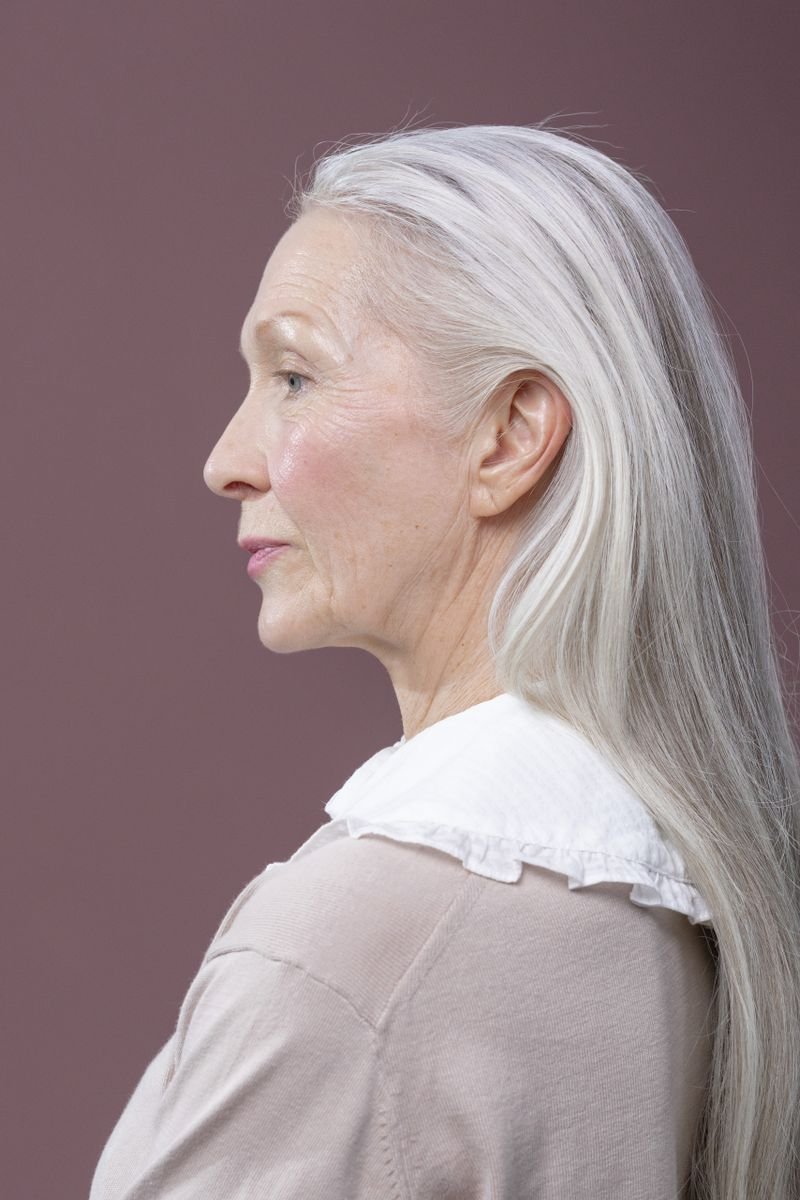
Photo: Pexels
Makeup and Wardrobe Shifts That Make Grey Look Deliberate
Grey hair changes the frame around your face. The goal is not to look younger, but to look like a woman who chose her grey on purpose. Those small shifts make a grey hair transition look deliberate.
Start with your brows. Grey or fading brows can wash out the whole face once the hair turns silver, so fill them in softly with a pencil or powder one shade darker than your grey, not dark brown and not black.
For lips, a little colour goes a long way. A soft berry, rose, or warm red stops silver hair from making the face look pale, while a very pale nude lip can disappear completely.
Clothing colours matter too. Silver hair loves jewel tones, such as teal, emerald, navy, and plum, and looks lovely against black and white. Very pale pastels and beige at the neckline can wash some women out, so wear those shades away from the face or add a scarf in a stronger colour. Silver jewellery and bold-framed glasses suit grey hair beautifully.

Photo: Pexels
Special Cases: Henna, Dark Hair, Curly or Fine Hair, Damaged Hair
Henna. If you have used henna, tell your stylist before anything else. Henna coats the hair and reacts badly with bleach, and it can turn green or orange when a stylist tries to lift it. Ask for a strand test first, and expect the slow grow-out route to be the safest. Tell your stylist about henna before you start a grey hair transition.
Very dark hair. Dark dye against silver roots gives the strongest contrast. Blending is usually the kindest route, as it breaks the line up without heavy bleaching. Expect 12 to 18 months, and avoid any promise of silver in a single session.
Curly hair. Curls hide a grow-out line well, as the curl pattern breaks the line up. The challenge is dryness, so use a rich conditioner, avoid brushing curls dry, and ask your stylist to cut your hair dry, curl by curl.
Fine hair. Fine grey hair can look thin at the crown. A shorter cut with soft layers and a little root lift will make it look fuller.
Damaged hair. If your hair is already dry or breaking from years of dye and heat, do not add bleach to the problem. Choose the full grow-out or the dye-strip method, and spend the first three months on repair: weekly masks, no heat without protectant, and regular small trims.
Mistakes to Avoid
- Re-dyeing at month four. Months 3 to 6 are the hardest, and re-dyeing then means starting the whole clock again.
- Letting one stylist bleach everything in a single session. A full colour strip in one visit damages mature hair.
- Using purple shampoo every day. It is a toner, not a daily shampoo. Daily use dries hair out and can leave a lilac tint.
- Skipping trims to “grow it faster”. Hair grows from the roots, not the ends, so skipping trims only leaves split, straggly ends.
- Hiding henna from your stylist. Henna plus bleach can react badly. Always say so, and always ask for a strand test.
- Keeping the same makeup and wardrobe. Grey hair changes your colouring, so update your brows, lips, and neckline colours.
- Comparing your grey to someone else’s. Only about one woman in ten has an even, silvery grey all over, so build your plan around your own roots.
Frequently Asked Questions About a Grey Hair Transition
How long does a grey hair transition take?
For most women, 12 to 24 months for a full grow-out, 6 to 18 months with blending, and 3 to 6 months with a big chop. Your grey hair transition timeline depends on your length and your route.
Will going grey make me look older?
Not if it is done well. What ages a look is dull, yellowed, or badly cut grey hair. Bright, well-kept silver hair and a good cut will make grey look polished at any age.
Is purple shampoo really necessary?
For most women, yes, at least once a week. Grey hair picks up yellow tones from sun, heat, and water, and purple shampoo is the simplest way to cancel that yellow.
Can I transition if my hair is very dark?
Yes, but expect it to take longer and cost more at the start. Blending is usually the best route for dark hair, and you should plan for 12 to 18 months.
What if I hate the middle stage and want to quit?
That feeling is normal, and it usually hits around months 3 to 6. Before you re-dye, try one blending appointment, a fresh cut, or a toner, and give it two weeks.
You May Also Like
Going grey is not about giving up on your hair. It is about stopping a routine that no longer serves you and choosing a colour that is already yours. The grow-out months ask for patience and a little care, but the end of a grey hair transition is simple and freeing: hair that looks like you, and a colour nobody else has.