How to Choose a Haircut for Your Face Shape — The Complete Guide
Two women can walk into the same salon, ask for the same haircut they saw in the same photo, and walk out with completely different results. The haircut is not the problem. The difference is almost always face shape. A cut that looks soft and balanced on an oval face can make a round face look wider, and the sharp bob that looks stunning on a square jaw can look harsh on a heart-shaped face. Choosing a haircut for your face shape this way avoids copying a style that suits someone else. The right hairstyle starts with those measurements, not with a photo.
This guide does one job properly: it helps you find your real face shape, understand what your shape needs, and choose a haircut that works with your features instead of fighting them. No vague advice, no copy-paste lists. By the end, you will know your shape, your best three or four cuts, the styles to skip, and the exact words to use at the salon. In short, choosing a haircut for your face shape means matching the cut to your measurements, not to a photo alone.
Step 1: Find Your Face Shape (The Honest Way)
Most women guess their face shape, and most guess wrong. Do this properly once and every future haircut decision gets easier. You need a mirror, a flexible measuring tape (or a piece of string and a ruler), and two minutes.
The mirror test. Pull your hair fully back, away from your face. Stand in good light and look straight ahead. Now trace the outline of your face on the mirror with a lipstick or a washable marker, following your hairline, temples, cheekbones, jaw and chin. Step back. The outline you drew is your true shape, without hair distracting you.
The four measurements. Measure these, in inches or centimetres, and write them down:
- Face length: from the centre of your hairline to the tip of your chin.
- Forehead width: across the widest point of your forehead, usually halfway between your brows and hairline.
- Cheekbone width: from the outer corner of one cheekbone to the other, just below the eyes.
- Jawline width: from below one ear, along the jaw, to the same point on the other side, passing under the chin.
Now compare. If all four numbers are close and your jaw is curved, you are round. If the length is clearly greater than the width and everything tapers softly, you are oval. If forehead, cheekbones and jaw are all similar widths with a strong, angled jaw, you are square. If the forehead is the widest point and the chin is narrow or pointed, you are heart. If the face is much longer than it is wide, you are long (oblong). If the cheekbones are the widest point by far, with a narrow forehead and jaw, you are diamond.
Between two shapes? That is normal. Most faces are a blend. Pick the shape your measurements lean toward, then read both sections in this guide and follow the advice that overlaps. The overlap is your safest zone.
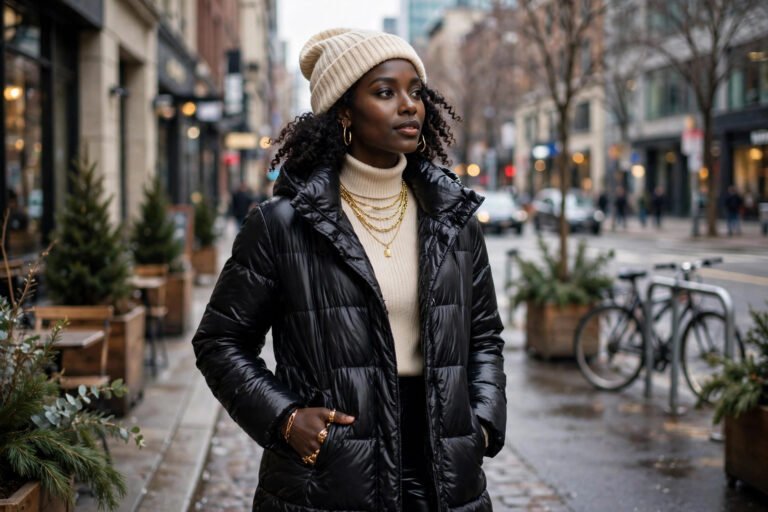
Photo: Pexels
The Six Face Shapes at a Glance
Oval
Length is about one and a half times the width. Forehead and jaw are gently rounded, cheekbones slightly wider than both. The most balanced shape — and the reference point every other shape’s styling tries to echo.
Round
Length and width are nearly equal, with soft curves everywhere and no sharp angles. Cheeks are full, the chin is rounded, and the jawline has no hard corners.
Square
Forehead, cheekbones and jaw are close in width, and the jaw is strong and defined. The sides of the face are fairly straight. Striking and photogenic — the goal is softening, not hiding.
Heart
A wide forehead and cheekbones that narrow down to a slim jaw and a small, sometimes pointed chin. Many heart faces also have a widow’s peak hairline.
Long (Oblong)
The face is noticeably longer than it is wide, with a forehead, cheekbones and jaw of similar width. Features can look drawn downward if the hair adds more length.
Diamond
Cheekbones are the widest point, the forehead and jaw are both narrow, and the chin is often pointed. Rare, angular, and made for showing off cheekbones.
Round Face: Add Length and Angles
Your goal is simple: make the face look longer and more defined. Hair should add height at the crown and fall past the chin, so the eye travels up and down instead of side to side. Long layers that start below the chin are your best friend — they cut the width visually without touching the fullness of your cheeks. A deep side part creates an angle where nature gave you curves, and side-swept bangs do the same job. Asymmetric cuts, long bobs that end at the collarbone, and soft waves with volume at the roots all work beautifully.
Be careful with chin-length blunt bangs, centre parts with flat sides, and round, curly volume at cheek level — all three add width exactly where you least want it. If your hair is fine, ask for layers that begin lower, not shorter, so you do not lose the lengthening effect.
If you are over 50 and want ready-made examples, our guide to slimming haircuts for round faces over 50 shows the shapes that work best, with lengths and layers explained for each one.
Oval Face: Almost Everything Works — Except Two Traps
An oval face suits nearly every haircut: pixies, bobs, long layers, blunt cuts, curtain bangs. Your decisions can be based on hair texture and lifestyle instead of shape rules. But two traps catch oval faces. The first is a very long, heavy, one-length style with a centre part — it drags the face downward and makes it read as long. The second is thick, straight-across bangs, which shorten the face and hide its balance. If you love long hair, keep layers around the face. If you love bangs, keep them wispy or swept. Everything else is honestly yours to choose.

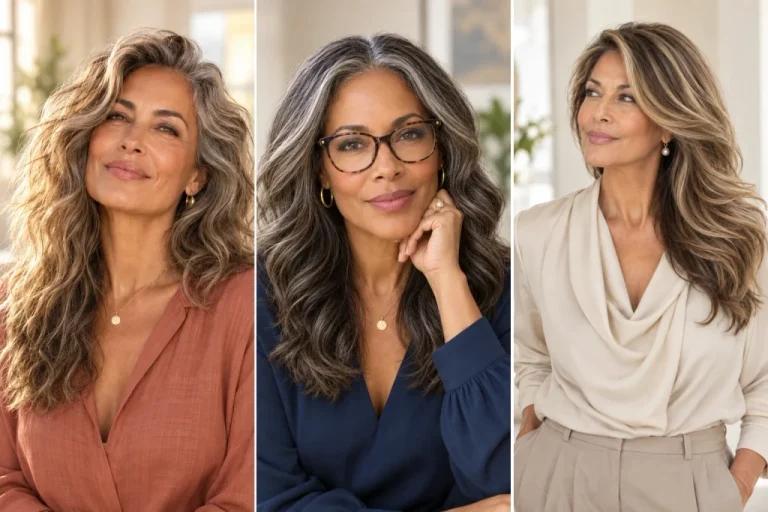
Photo: therighthairstyles.com
Square Face: Soften the Angles
A square face has presence. The job of the haircut is to soften the jaw and forehead corners so the whole face looks balanced, not boxy. Texture is your tool: soft layers, waves, curls and feathered ends all break up straight lines. Shoulder-length cuts with layers that start at the cheekbones draw the eye upward. A side part softens a strong forehead far better than a centre part, and long, side-swept bangs blur the corner where forehead meets temple. Wispy, rounded fringes work; blunt, straight-across fringes do the opposite.
Avoid blunt bobs that end exactly at the jaw — they underline the widest, strongest part of your face. Avoid slicked-back styles and severe centre parts, which expose every angle. If you want short hair, a textured, layered pixie with softness around the hairline works far better than a sharp geometric cut.
Heart Face: Balance Top and Bottom
Your forehead is the widest part of your face, so the haircut should do two things: calm the top down and give the jaw area a little more presence. Side-swept bangs are made for you — they cover part of the forehead and break its width. Layers and waves that begin at the cheekbones and grow fuller toward the ends add the visual weight your lower face needs. Chin-length and shoulder-length bobs are excellent, because the ends sit right at the jaw and make it look stronger. Textured lobs are a safe everyday choice.
Skip very short, blunt bangs, which make the forehead look wider, and avoid heavy volume at the crown. Also be careful with long, fine, straight hair with no layers: it hangs from a wide forehead down to a narrow chin and exaggerates both. If your chin is pointed, keep the ends of your hair textured rather than blunt, so they do not point with it.

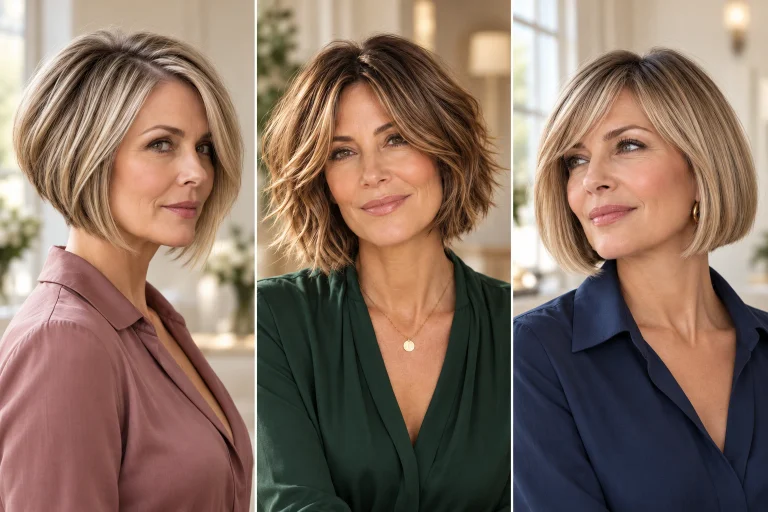
Photo: therighthairstyles.com
Long Face: Add Width, Not Height
Everything for a long face is about horizontal balance. You want width at the sides and nothing that stretches the face further downward. Waves, curls and layers that build volume at cheek level are ideal. Blunt bangs are one of the few styles that truly help, because they shorten the visible length of the face. Chin-length and shoulder-length bobs, worn with soft waves, are consistently flattering. A side part also helps, because it interrupts the long vertical line.
Avoid very long, straight, one-length hair — it is the single most lengthening style there is. Avoid volume piled only on top, high ponytails, and centre parts on flat hair. If you love long hair, the fix is layers plus waves, never poker-straight. Our collection of long hairstyles for women over 50 shows how to keep length while adding the width and movement a long face needs.
Diamond Face: Show Off the Cheekbones
Diamond faces are rare and striking, and the cheekbones are the main feature — the haircut should frame them, not cover them. Hair needs a little width at the forehead and at the chin to balance the wide centre. Chin-length bobs, shoulder-length cuts with layers, and side parts all do this well. Side-swept bangs add softness at the narrow forehead. Tucking hair behind the ears is a small trick that works wonderfully on diamonds, because it shows the cheekbones while the hair at the chin adds width below.
Avoid styles with heavy volume right at the cheekbones, which widen the widest point further, and avoid flat, centre-parted hair that makes the forehead look even narrower. Slick, tight ponytails can look severe; a low, soft ponytail with face-framing pieces is the better version.
Face Shape Is Only Half the Story
Here is what most guides leave out: face shape sets the direction, but three other things decide whether the cut actually works on you. That is why choosing a haircut for your face shape also means checking texture, glasses and routine, not shape alone.
Hair texture and thickness. The same bob behaves completely differently on thick, wavy hair and on fine, straight hair. Fine hair needs shorter layers and blunt ends to look full; thick hair needs weight removed so it does not form a triangle. If your hair is fine or thinning, the cuts in our guide to haircuts for fine, thin hair over 50 are chosen specifically to keep volume where you need it.
Glasses. Frames change the shape the world sees. Heavy frames add width at eye level, which helps long and diamond faces and can overwhelm round ones. If you wear glasses daily, take them to the salon and judge the cut with them on, not off.
Your real routine. A cut that needs twenty minutes of styling will look good for exactly one week if your real routine is five. Be honest about your mornings. A slightly simpler cut you style well every day beats a perfect cut you never style at all.

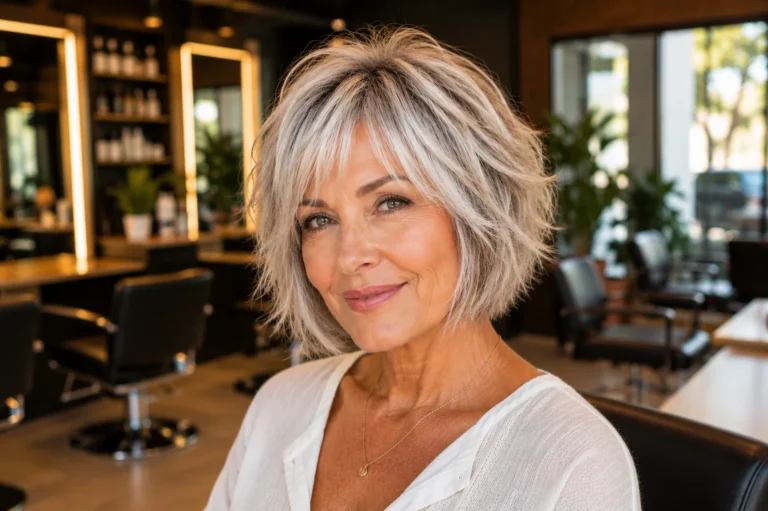
Photo: latest-hairstyles.com
7 Mistakes That Ruin an Otherwise Good Haircut
- Copying a photo without checking the model’s face shape. Inspiration photos are a starting point, not a promise. Always ask: is her shape like mine?
- Choosing the length first and the shape second. Length is the last decision. The outline of the cut matters more than whether it is short or long.
- Ignoring the jawline. Where the ends of your hair sit is where the eye lands. Ends at your widest or sharpest point will emphasise it.
- Forgetting that hair changes the shape too. A fringe shortens a face. A deep side part narrows it. Volume at the sides widens it. Use these like tools, not accidents.
- Skipping the grow-out question. Ask how the cut will look in six weeks, not just today. A good cut grows out gracefully.
- Judging the cut wet and styled by someone else. Ask the stylist to show you the finish with the amount of styling you will actually do at home.
- Changing everything at once. New length, new shape, new colour and new fringe together means you will never know which change you dislike. Change the cut first.
Before You Book: A 10-Minute Checklist FOR CHOOSING A HAIRCUT FOR YOUR FACE SHAPE
Do these five things and you will walk into the salon clearer than most clients. One: measure your face and name your shape. Two: save three photos of cuts on faces shaped like yours — not just hair you admire. Three: decide your non-negotiables (length you will not go above, fringe yes or no, styling time). Four: note your hair’s honest texture on a normal day, not a salon day. Five: prepare one sentence for the stylist: your shape, your goal, your limit. For example: “My face is round, I want it to look longer, and I do not want to go shorter than my collarbone.” That one sentence prevents most haircut regrets. Keep this checklist beside you when you are choosing a haircut for your face shape.
See healthy hair tips from the American Academy of Dermatology.
Frequently Asked Questions
Can my face shape change as I get older?
Yes, it can shift. As skin loses firmness and the jaw softens, a square face can read rounder and an oval face can read longer. Re-measure every few years, and choose cuts that add structure — layers at the cheekbones and gentle volume at the crown — rather than relying on the shape you had at 30.
What if my measurements fall between two shapes?
Treat yourself as the blend you are. Follow the advice that both shapes share, and avoid the extremes of either. For example, a round-square blend should add length like a round face and add soft texture like a square face, while avoiding both blunt jaw-length cuts and heavy side volume.
Do bangs suit every face shape?
Almost — the style of bang changes, not the idea. Blunt bangs help long faces, side-swept bangs help round, square and heart faces, and wispy bangs are the safe choice for oval and diamond faces. The mistake is not bangs; it is the wrong bang for your shape.
Should fine or thinning hair follow the same rules?
The shape rules stay the same, but the construction changes. Fine hair needs blunt ends and shorter, fewer layers to look thick; asking for lots of long layers removes the little weight fine hair has. Shape first, then adapt the cut to your density.
How do I know a haircut suits me before I commit?
Use the checklist above, then do the photo test: hold your saved photos next to your mirror image and compare outlines, not details. If the outline of the cut balances your outline on paper, it will almost always work in the chair. When in doubt, choose the more conservative version first — you can always go shorter at the next visit.
You May Also Like
- Bob Haircuts for Women Over 60 That Add Volume and Youth
- Slimming Bob Haircuts for Women Over 60 With Round Faces
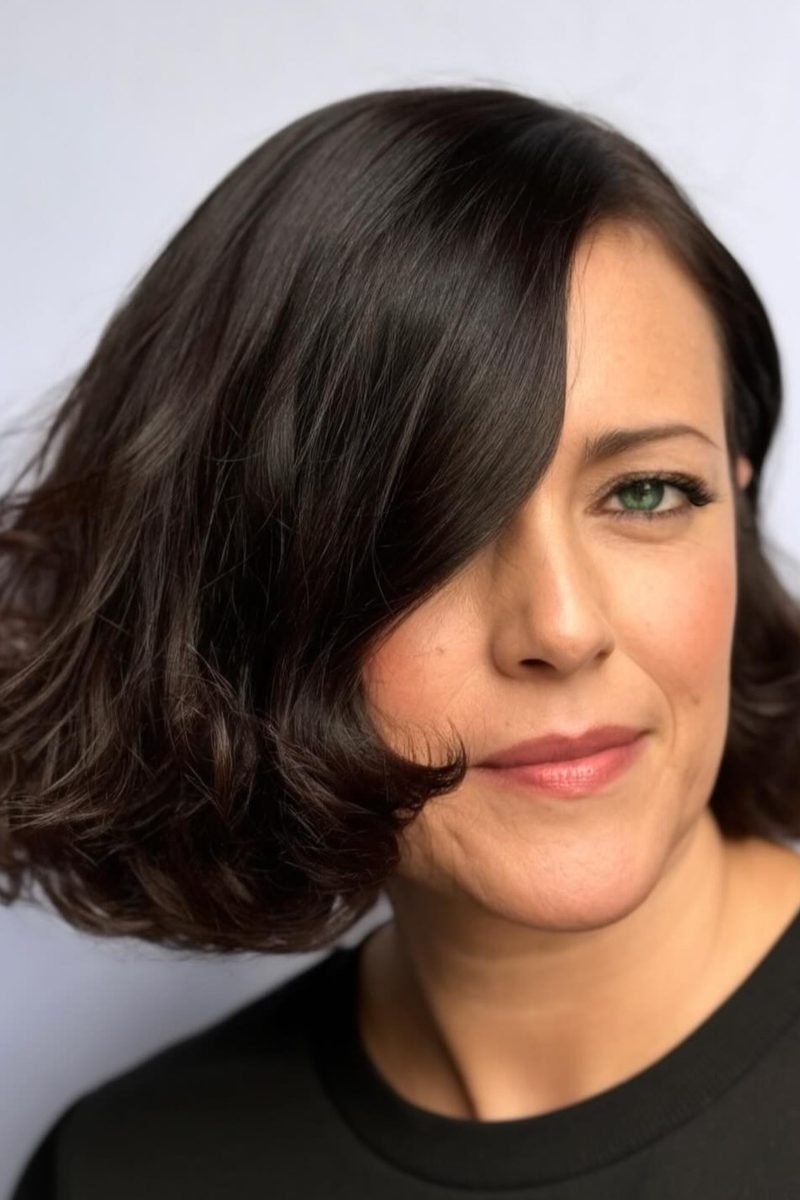
Photo: therighthairstyles.com